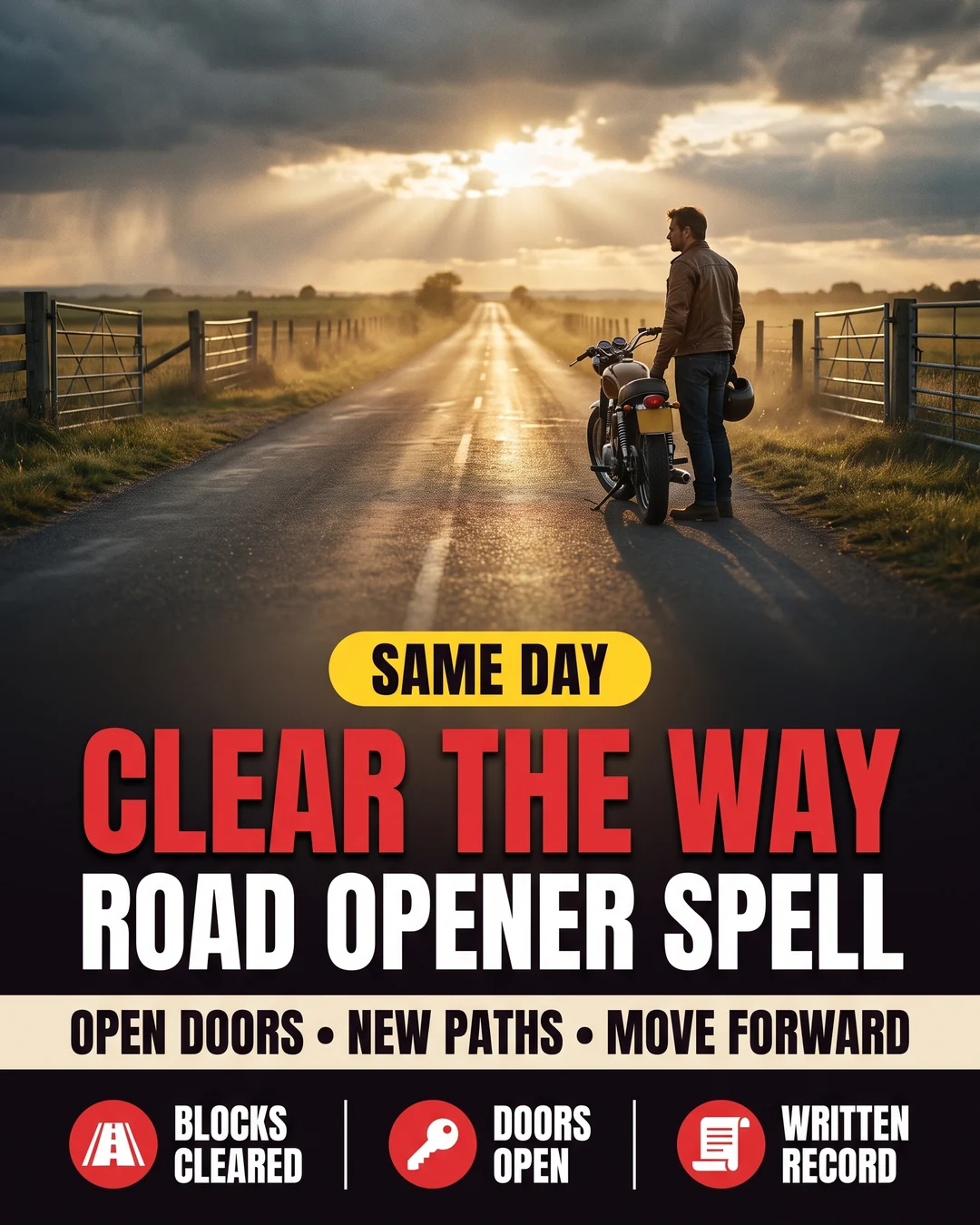
What a road opener spell is, and when it is the right one
An Abre Camino, which simply means "open the way", is the working you reach for when nothing in particular has gone wrong and nothing at all is moving. Applications that go nowhere. Plans that stall for different reasons each time. A run of bad timing long enough that it has stopped feeling like timing.
Other workings go after a single named problem. This one does not. It draws the whole road and clears everything standing on it, one thing at a time, and that is why it is the most-requested working in folk practice across the whole of the Spanish-speaking world.
Who orders the Abre Camino
- Someone who cannot point at one obstacle, only at a general feeling of pushing and nothing giving.
- Someone whose luck seems to break in a different place every time it breaks.
- Someone starting again after a long stuck period and wanting the way clear before they begin.
- Someone whose wish is not love at all but movement.
If you can name one specific blockage, a job, a person, a debt, there is usually a narrower working that does more. The road opener earns its keep when the list is long.
How Abre Camino is cast, step by step
- A road is drawn in chalk across the table, from where you are standing now to where you are trying to get to. It is drawn, not imagined; the whole working takes place along that line.
- Seven stones are set along it. Seven is the traditional number for a full road; a shorter road takes five, and your record says which yours took and why.
- Every stone is named aloud before it is touched. This is the part that takes the longest and it is not decorative. An obstruction that has never been named can only be walked around, and walking around is what has been happening.
- A white candle burns at the near end for clearing, a yellow at the far end for movement. Two candles, two jobs; a road opener lit with only one tends to clear without moving.
- The stones are lifted one at a time, lightest first, and each is set aside rather than put back down on the line. The heavy one is always last.
- A key is laid at the far end of the emptied road, and left there.
Every item on the altar, and why it is there
- The chalk. The road itself. Chalk is used because it is temporary: a road that is meant to be walked is not painted on permanently.
- The seven stones. The blockages, given weight and a name so they can be handled rather than described.
- The white candle. Clearing, at the end nearest you.
- The yellow candle. Movement and opportunity, at the end you are heading toward.
- The key. What waits at the end of a cleared road. It opens nothing on my table; it is there to be claimed.
The seal, and why the road is wiped
The seal of Abre Camino is the emptied road with the key at the end of it.
Then the chalk is wiped. That surprises people, so it is worth saying plainly: a cleared road left lying on a table is not a cleared road, it is an unfinished one. The wiping is the closure. What remains is the key, and the key stays where it was put until the door it belongs to turns up.
This is also why a road opener is not re-cast every fortnight. The road was drawn and cleared once. Drawing it again a week later says the clearing was not believed.
What your written ritual record contains
- The intention. Your words, and the shape of the blockage as I read it, which is often broader than the way it was described.
- The road. How it was drawn and how many stones it took.
- The stones, one by one. What each one was, in the order they came up. This is the part of the record people return to, because the fifth stone is rarely what they expected.
- The seal. The key, the wiped chalk, and what that means for your situation.
- What moves first. For a road opener, the earliest sign is usually a result arriving from somewhere you were not watching.
- Your part. One thing, free, and never a condition of the outcome.
What I need from you before I begin
Your first name, your date of birth if you have it, and what feels blocked, in your own words. You do not need to list the obstacles; naming them is my part of the work and the naming is where the value of this working sits.
Write what the stuckness actually feels like from inside it. "Everything takes three attempts" tells me more than a tidy list of problems.
The strengths, and what changes between them
- Standard Casting — one night: one road, seven stones, one record.
- 3x Casting — the road is drawn on three nights, and stones that resisted on the first night are worked again.
- 7x Casting — seven nights, one stone carried per night, which is the traditional shape of this working and the one I would choose for a long stuck period.
- Fast, Extreme and Ultimate — longer carriage, with the record written across the whole of it.
Abre Camino is one of the few workings where the seven-night version is meaningfully different in structure rather than only in length.
What people notice in the days after
First, the small stuff stops sticking. A form goes through. A call is returned. Nothing important happens and the friction drops, and this is the sign most people fail to notice because it is made of absences.
Second, a result arrives from a direction you were not watching. Road openers are known for this. The door that opens is rarely the one being knocked on.
Third, the thing itself, and usually later than the first two by a fortnight or more.
Frequently asked questions
What does Abre Camino actually mean?
It is Spanish for 'open the way'. It is the best known road-clearing working in folk practice and it is used when the trouble is general rather than specific: stalled plans, bad timing, doors that keep not opening.
How is a road opener different from a luck spell?
A luck working adds something. A road opener removes what is in the way. If your plans are good and nothing is moving, clearing usually does more than adding, and it is the cheaper of the two mistakes to make.
Why seven stones?
Seven is the traditional count for a full road. Some roads take fewer and your record says how many yours took and why. The count is read from your situation rather than decided in advance.
Do I need to know what is blocking me?
No. Naming the blockages is my part of the working, and it is the part most people say they got the most out of. Tell me what being stuck feels like and leave the naming to the stones.
How long before the road opens?
The friction usually drops inside two weeks and the first real result tends to come from an unexpected direction after that. Your record gives the timing I see for your road rather than a standard figure.
Can I order a road opener alongside another working?
Yes, and it is a common pairing. A road opener clears the ground; a named working walks it. If you are unsure which order to take them in, the record for whichever you cast first will say.
Road Opener Spell
A road drawn in chalk, seven stones named and lifted, and a key at the cleared end. Cast the same day, with your full written record afterwards.